Book online and pay the balance at pickup with debit card or cash on eligible cars across all seven emirates.
The United Arab Emirates stretches 450 kilometres from the Saudi border in the west to Oman in the east, and driving remains the only practical way to explore beyond a single city. Dubai lies 140 km from Abu Dhabi on the E11 motorway, Sharjah sits 25 km northeast of Dubai, Fujairah waits 130 km across the Hajar mountains, and Al Ain rests 160 km inland on the border. Public transport between emirates is limited, taxis cost hundreds of dirhams for inter-city trips, and ride-hailing apps refuse long journeys during peak hours. A rental car turns a fragmented itinerary into a continuous route, letting you leave Dubai Marina at dawn, photograph Sheikh Zayed Grand Mosque by noon, and reach Jebel Hafeet for sunset without waiting for bus schedules or negotiating fares.
We work with local rental companies in Dubai, Abu Dhabi, Sharjah and every other emirate to offer car rental UAE no deposit and no credit card on most models in the search results. When you run a search through the widget above, each car displays its payment terms: vehicles marked "No Deposit" require no blocked funds at pickup, and nearly all accept debit card or cash for the balance. The rare exceptions - typically premium sedans or new SUVs - show their deposit amount and preferred payment method in the listing, so you know the full requirement before you click. This approach gives travellers without a credit card the same choice of sedans, compact SUVs and seven-seater MPVs that others enjoy, because each vehicle's conditions depend on the rental company's policy for that specific model, not on arbitrary customer categories.
You pay a booking advance by card on our site to confirm the reservation, then settle the remaining rental charge at pickup using the method stated in your voucher - debit card, cash or credit card, depending on what the rental company accepts for that car. The voucher also lists any extras you ordered: a second driver, child seat, Salik toll tag registration, or a cross-border permit for Oman. A deposit, when required, is a temporary hold by the rental company at the counter; it exists independently of insurance coverage, and every car carries an excess - the amount you would pay toward repairs if the vehicle is damaged. Rent a car UAE without deposit simply means no funds are blocked, not that liability disappears.
Pickup happens at the rental company's desk inside DXB or AUH terminal, at a meet-and-greet point outside SHJ or RKT airport, or by hotel delivery in the city - the exact location and opening hours appear in your voucher after booking. You sign the rental agreement on site, the staff note existing scratches and tyre condition in the contract, and you drive away with the company's emergency number saved in your phone. Return works the same way: hand back the keys, wait for the final inspection, and leave once the attendant confirms no new damage.
We connect you to rental desks across every emirate, showing real-time availability and transparent payment terms so you can compare models and book in minutes. No queues at airport kiosks, no phone calls to negotiate prices, no hidden conditions discovered only at pickup.
Most vehicles in search results carry no blocked funds at pickup, letting you rent a car without deposit and keep your cash or debit-card limit available for fuel, hotels and excursions during the trip.
Nearly every car accepts debit card or cash for the balance payment at pickup, so you do not need a credit card to drive in UAE. If a model does need one, the listing warns you before booking.
Pay the advance online by card, then choose debit card or cash at the counter for the remaining amount. Each car's voucher specifies which methods the rental company accepts for that vehicle.
Change your flight or adjust your itinerary free of charge. Cancel online up to the time stated in your booking terms and receive a full refund of the advance within five business days.
Collect your car at a desk inside Dubai, Abu Dhabi or Sharjah terminal, meet a driver outside Ras Al Khaimah airport, or ask for hotel delivery in the city. The choice appears during search.
Every sedan, SUV and MPV in UAE comes with automatic gearbox and air conditioning as standard equipment, because manual cars are almost unknown in the local market and summer heat makes cooling essential.
Driving opens up landscapes that buses never reach and itineraries that taxis cannot afford. These eight routes connect the country's iconic landmarks, mountain roads, coastal stretches and desert tracks, each demanding a different type of car and a specific approach to speed limits and road conditions.
From DXB airport drive 15 km west on Airport Road, merge onto Sheikh Zayed Road and take the Financial Centre exit; journey time twenty-five minutes outside rush hour. Downtown multi-storey car parks charge by the hour; street parking is metered until 22:00. Sheikh Zayed Road runs six lanes in each direction with a 100 km/h limit and gantry cameras every few kilometres, so cruise control helps avoid fines. Any economy sedan such as the Hyundai Accent handles urban stop-and-go traffic and fits into tight parking bays, while a compact SUV like the Hyundai Creta offers higher seating if you prefer better visibility in dense lanes. The route crosses two Salik toll gates - one at Airport Road and one near interchange one - debited automatically if you ordered the tag at booking.
Follow the E11 motorway 140 km southwest from Dubai; speed limit 140 km/h on most sections, dropping to 120 km/h near Ghantoot and 100 km/h approaching the city. Cameras are frequent and enforce the limit strictly, so set the cruise five below the posted number. The Corniche stretches eight kilometres along the waterfront with free parking in marked bays before 08:00 and after 20:00; during the day expect metered spots or paid garages. The Grand Mosque lies five kilometres inland on the Sheikh Rashid bin Saeed Street; ample free parking surrounds the visitor centre. An intermediate sedan such as the Hyundai Elantra offers motorway comfort and decent boot space for luggage, though families often choose the Kia Sorento seven-seater to spread out on long drives. Total journey from central Dubai two hours; add thirty minutes if you start from Sharjah or northern emirates.
Head 160 km east from Abu Dhabi or 160 km southeast from Dubai on the E22 and E66 highways, crossing flat gravel plains before the road rises into the foothills. Speed limits alternate between 140 km/h and 120 km/h; cameras cluster near every junction and roundabout. Al Ain Oasis sits in the city centre with free parking along the perimeter fence. Jebel Hafeet lies twelve kilometres south: the 11.7 km mountain road climbs 1,200 vertical metres through sixty hairpin bends, each marked with gradient and radius signs. Surface is smooth tarmac but shoulders are narrow, so an SUV with responsive brakes - Hyundai Tucson or larger - gives confidence on the descent. Views open across Oman and the Empty Quarter from the summit cafe at 1,249 metres elevation. Return via the same route or loop north through Hatta if you hold a cross-border permit and want to dip into Omani territory for an hour.
Drive 130 km southeast from Dubai on the E44 Hatta highway, speed limit 120 km/h with cameras every ten kilometres after you leave the urban sprawl. The road passes through a wedge of Omani territory near the border; keep your passport in the glovebox because checkpoints occasionally ask for ID, though no visa is needed for the transit. Hatta village sits in a valley surrounded by the Hajar range; park near the heritage village museum or continue four kilometres to the Hatta Dam picnic area, where a gravel track leads to kayak-launch points. Any automatic sedan manages the paved sections, but if you plan to explore unsigned wadi tracks beyond the dam you need an SUV with higher clearance - consult our pickups and SUVs for mountain roads if that appeals. Return the same way or make a triangle via Al Ain if time allows, adding two hours to the trip.
Sharjah lies 25 km northeast of Dubai along the E11; exit at Sharjah airport or continue to Al Wahda Street for the heritage district. Traffic is dense during morning and evening peaks, so allow forty-five minutes door to door. Street parking in the old city costs a few dirhams per hour via mParking app; museum car parks are free but fill quickly on weekends. The Museum of Islamic Civilization, Sharjah Art Museum and Heritage Area cluster within one square kilometre, all walkable once you park. A compact sedan like the Kia Pegas suits short city hops and tight parking; bigger vehicles feel cumbersome on the narrow lanes around Souk Al Arsah. If you base in Sharjah and plan day trips to Dubai or Abu Dhabi, pick up the car at SHJ airport desk to skip the taxi ride from your hotel, then return it to the same location when you leave.
Cross the Hajar range from Dubai or Sharjah on the E102, 130 km to Fujairah city; the road climbs through rock cuttings and tunnels, speed limit dropping to 80 km/h on curves and rising to 120 km/h on straight stretches. Al Bithnah fort marks the halfway point; stop for photos but watch for gravel on the shoulder. Fujairah Corniche offers free beachfront parking; Al Aqah beach resorts twenty kilometres north have paid hotel lots or roadside bays. Offshore rocky islands attract snorkellers; calm water most of the year except June monsoon swell. An intermediate SUV like the Hyundai Tucson handles the mountain gradients and gives space for dive gear or beach equipment. Return via the same route or make a loop north through Dibba and Ras Al Khaimah, adding ninety kilometres and two extra hours but rewarding you with coastal scenery and fewer trucks than the main pass.
From Dubai follow the E11 north for 115 km, branching onto the E18 past Umm Al Quwain; speed cameras are frequent and the limit holds at 120 km/h until you reach RAK city. Jebel Jais, the UAE's highest peak at 1,934 metres, lies thirty kilometres inland on a smooth mountain road with twenty hairpins and a 12 percent gradient in places. Summit viewing platform and zipline base occupy the top; free parking, but arrive before 10:00 on weekends to avoid the queue. An automatic SUV such as the Chevrolet Traverse handles the climb without strain and carries six adults comfortably if you bring a group. On the way back detour into the dunes near Khatt village for a taste of sand driving, though deep dune-bashing needs a proper 4x4 - sedans and crossovers should stay on graded tracks. Return to Dubai in ninety minutes if traffic is light.
Head 240 km southwest from Abu Dhabi on the E11 and E45, the last eighty kilometres crossing flat sabkha and low dune ridges. Road is straight and fast - 140 km/h on the E11, 120 km/h on the E45 - but watch for camels near Madinat Zayed. Liwa village sits on the northern edge of the Rub al Khali; paved roads run between date farms and a few small hotels, but venturing into the dune sea itself demands a 4x4 with low-range gears and an experienced driver. If you simply want to photograph the rolling sand and visit Qasr Al Sarab viewpoint, a two-wheel-drive SUV suffices as long as you stay on tarmac. Fuel up in Abu Dhabi because stations are sparse; carry extra water and check tire pressure before the return leg. Round trip from the capital takes six hours driving time; add stops and you fill a full day.
Local fleets favour Japanese and Korean brands for their parts availability, air-conditioning performance and automatic transmissions. The table below shows common models and their typical use cases; actual availability appears when you search dates and pickup location in the widget.
| Car Model | Category | Transmission | Best For |
|---|---|---|---|
| Hyundai Accent | Economy sedan | Automatic | City errands and short trips |
| Kia Pegas | Compact sedan | Automatic | Daily commutes in Dubai and Sharjah |
| Hyundai Elantra | Intermediate sedan | Automatic | Business trips and motorway comfort |
| Hyundai Creta | Compact SUV | Automatic | Families and weekend desert trips |
| Hyundai Tucson | SUV | Automatic | Longer drives and light offroad |
| Kia Sorento | 7-seater SUV | Automatic | Groups and inter-emirate travel |
| Hyundai Staria | MPV | Automatic | Large families and luggage |
| Chevrolet Traverse | Full-size SUV | Automatic | Comfort on long motorway stretches |
These models represent typical offerings; search results will also include equivalent cars from Nissan, Mitsubishi, Toyota and other brands depending on which rental company serves your chosen location. If you plan to tackle gravel mountain tracks, wadi beds or serious sand dunes, look at our SUVs and pickups for mountain roads page, which lists high-clearance vehicles with part-time or full-time four-wheel drive and the necessary recovery equipment.
The entire process happens online: search, compare, pay the advance, receive your voucher. No phone calls, no office visits, no paperwork posted. You walk straight to the rental desk with a booking reference and drive away in under fifteen minutes.
Enter your pickup city, dates and time in the widget at the top of this page. Results load in seconds, showing every available car with its daily rate, payment terms and deposit requirement. Filter by "No Deposit" if you want only vehicles that need no blocked funds, or sort by size if you need seven seats or extra boot space. Each listing states whether the car accepts debit card, cash or credit card for the balance payment.
Click the car you want, review the rental conditions, add any extras - child seat, second driver, toll tag, Oman permit - then proceed to payment. You pay a booking advance by card on our secure page; the advance holds your reservation and comes off the total rental cost. The remaining balance is due at pickup using the method stated in the booking summary. Our system sends a confirmation email within minutes.
Check your inbox for the voucher PDF, which lists the rental company's name, desk location, opening hours, emergency contact number, and every detail of your booking: car model or equivalent, pickup and return time, insurance coverage, excess amount, fuel policy and the balance due. Print the voucher or save it on your phone; you will show it at the counter along with your passport, driving licence and payment card.
Go to the desk or meet-point shown in the voucher, present your documents, sign the rental agreement and walk around the car with the attendant to note existing scratches, dents or tyre wear in the contract. Pay the balance, take the keys, photograph the fuel gauge and odometer, then drive. At return the staff inspect the car, check the fuel level matches the policy - almost always full-to-full - and release you once they confirm no new damage has occurred.
Rent a car without deposit means the rental company does not block any amount on your card or ask for cash to hold against potential damage. You still carry an excess - the liability you pay if the car is damaged - but your funds remain available throughout the trip. This policy applies to most vehicles at most locations; the handful of exceptions show their deposit requirement in the search results before you book.
Each car in the search results displays its deposit status. Vehicles marked "No Deposit" need no blocked funds at pickup; you pay only the rental balance and any extras you ordered. In every emirate practically all cars on offer need no credit card and carry no deposit - the rare exceptions are shown in the listing so you see the full picture before clicking. Use the filter panel to display only no-deposit cars if that is your firm requirement. The deposit - when present - is independent of insurance coverage: you still have a collision-damage waiver with an excess, and that excess remains whether or not a deposit is taken. The two concepts are separate, and no deposit simply means your bank account or card limit is not tied up during the rental period.
We work with rental companies that operate in one or two emirates, not multinational chains. These local businesses check every booking manually, read customer reviews before approving reservations, and maintain a no-hidden-fee policy that builds long-term trust. Renters who know they are not facing surprise charges or confusing deposit rules tend to drive carefully and return the car on time. The companies also fit GPS trackers as standard, so a vehicle cannot disappear, and they hold the renter's passport copy and licence details in the contract signed at pickup. Together these measures reduce risk enough that most cars need no upfront hold, letting travellers without a credit card or a large card limit enjoy the same choice as everyone else.
The rental company will ask for the following items at pickup; have them ready in a folder or phone wallet to speed the process:
If you want to know which payment methods apply to your chosen car, or you need advice on raising your debit-card limit before travel, visit our payment methods page for detailed guidance.
Traffic rules are strict, enforcement is automated, and road conditions vary from glass-smooth motorway to gravel wadi track. These eight practical points cover the situations you will meet most often, helping you avoid fines, delays and unnecessary stress.
Rental desks operate in all seven emirates, at international airports, city offices and hotel-delivery zones. Choose a pickup point close to where you land or stay, then drop the car at the same location or arrange a one-way return if your itinerary ends in a different emirate.
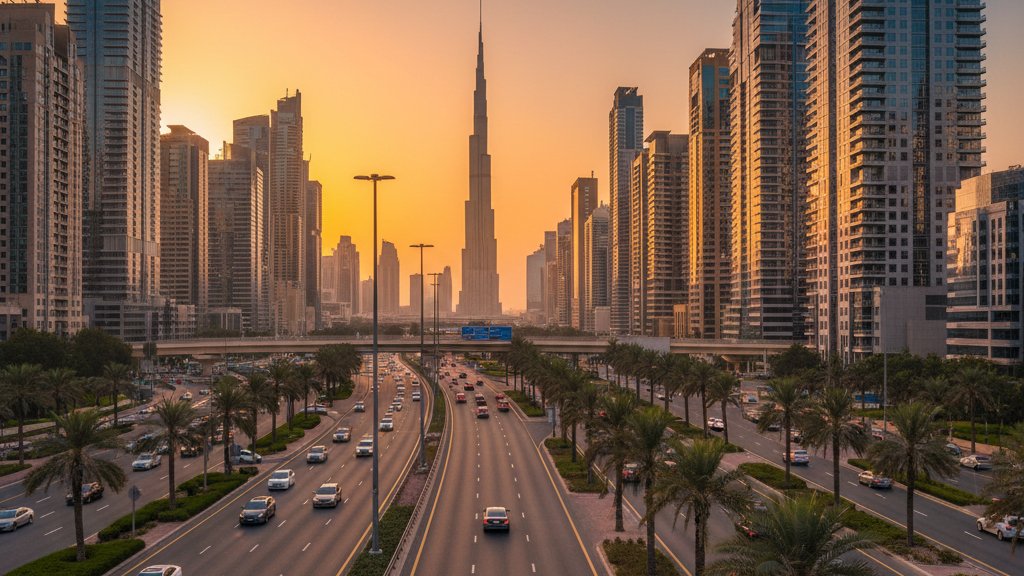
Dubai World Central Airport (DWC)
Dubai International (DXB) handles most international arrivals; rental desks line the ground-floor hall in Terminal 1 and Terminal 3, open every day. Al Maktoum International at Dubai World Central (DWC) serves budget carriers; the smaller terminal has three rental counters in the arrivals area, and staff wait at a meet-point outside if you book certain operators. City pickup happens at offices in Deira, Bur Dubai or near your hotel if you order delivery. Traffic on Sheikh Zayed Road is heavy 07:00-09:00 and 17:00-20:00; plan your first drive outside those windows or accept a slow crawl toward your hotel.
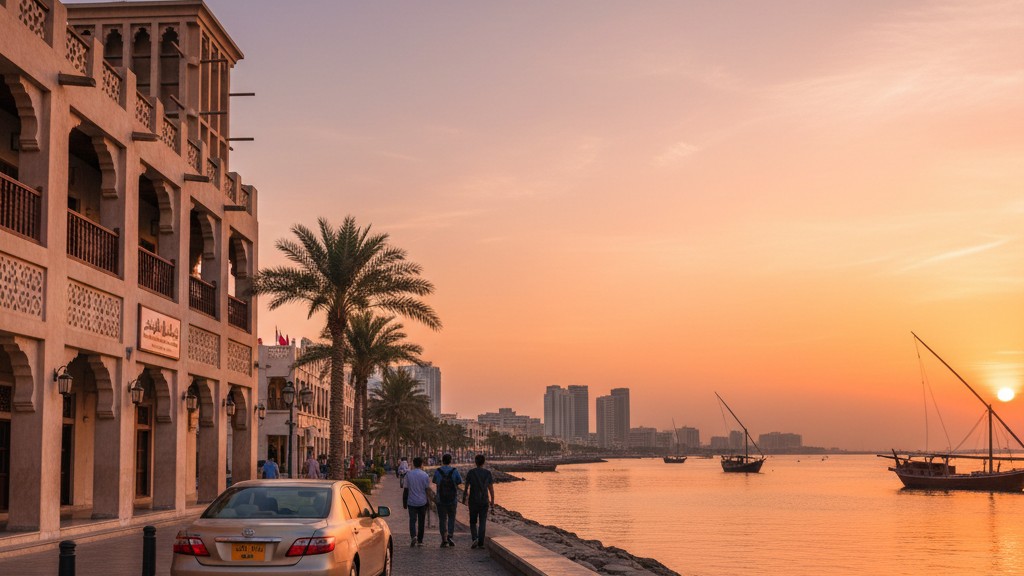
Sharjah International (SHJ) sits thirteen kilometres east of Sharjah city centre and twenty kilometres from Dubai. The terminal has two rental desks in the baggage-claim area; after hours some companies arrange a meet-and-greet outside the exit. Road access is straightforward: E11 motorway links Sharjah to Dubai in thirty minutes, E88 runs south to Ajman in ten. Pickup in Sharjah city happens at shops along Al Wahda Street or King Faisal Road; the rental company will send exact GPS coordinates in your voucher. Sharjah is often cheaper than Dubai for the same car, and you skip the airport-exit traffic jam that plagues DXB during evening rush.
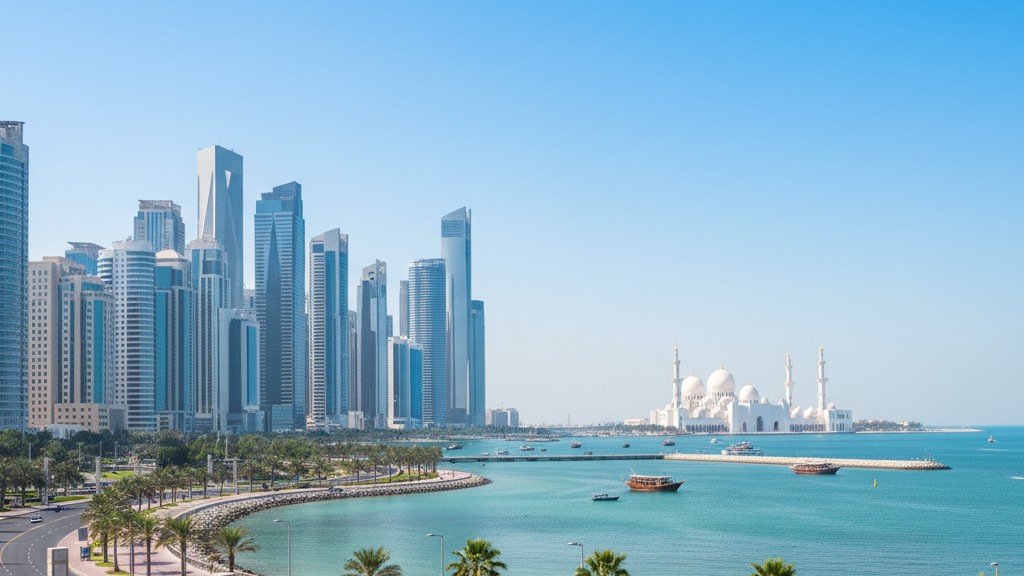
Abu Dhabi International (AUH) occupies a man-made island thirty kilometres east of downtown; rental counters occupy the arrivals hall between terminals one and three, and most open 24 hours. Pickup in the city is possible at offices on Airport Road, Corniche Road or near major hotel clusters; ask for delivery if you stay on Saadiyat Island or Yas Island and want to avoid the taxi fare. The E11 motorway connects Abu Dhabi to Dubai in ninety minutes; E22 and E65 run east to Al Ain. Parking downtown is metered; use the mowaqif app and feed the session if you plan to stay longer than the initial two-hour block.
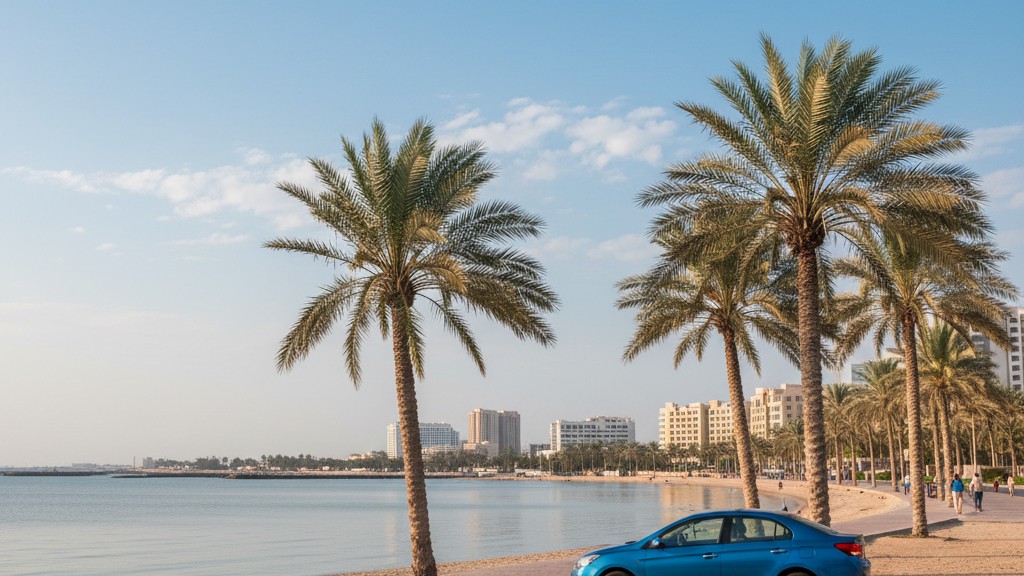
The smallest emirate, Ajman lies between Sharjah and Umm Al Quwain on the coast. No airport, so pickup happens at rental offices along Sheikh Khalifa Bin Zayed Street or near the Corniche. Ajman is fifteen kilometres north of Sharjah, ten minutes on the E11. Rental rates here often match Sharjah, and the compact size means you can walk to most hotels and beaches once parked. Use Ajman as a base if you want to explore the northern emirates - Umm Al Quwain, Ras Al Khaimah, Fujairah - without paying Dubai prices or fighting Dubai traffic.
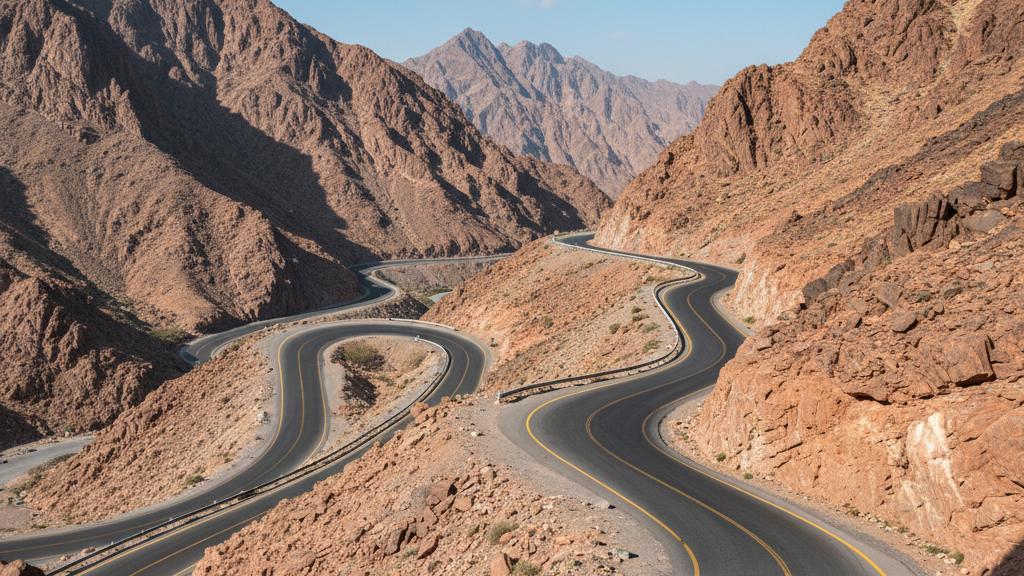
Ras Al Khaimah International (RKT) serves a handful of regional routes; the terminal is small, and rental desks operate by appointment rather than 24-hour shifts. Some companies meet you outside with the car ready; others ask you to take a taxi to their city office and collect there. RAK city lies 115 km north of Dubai on the E11, about ninety minutes' drive. The emirate is the gateway to Jebel Jais mountain road and the Hajar range; if you plan wadi hikes or dune drives, this is a logical pickup point because you avoid backtracking through Dubai's sprawl.
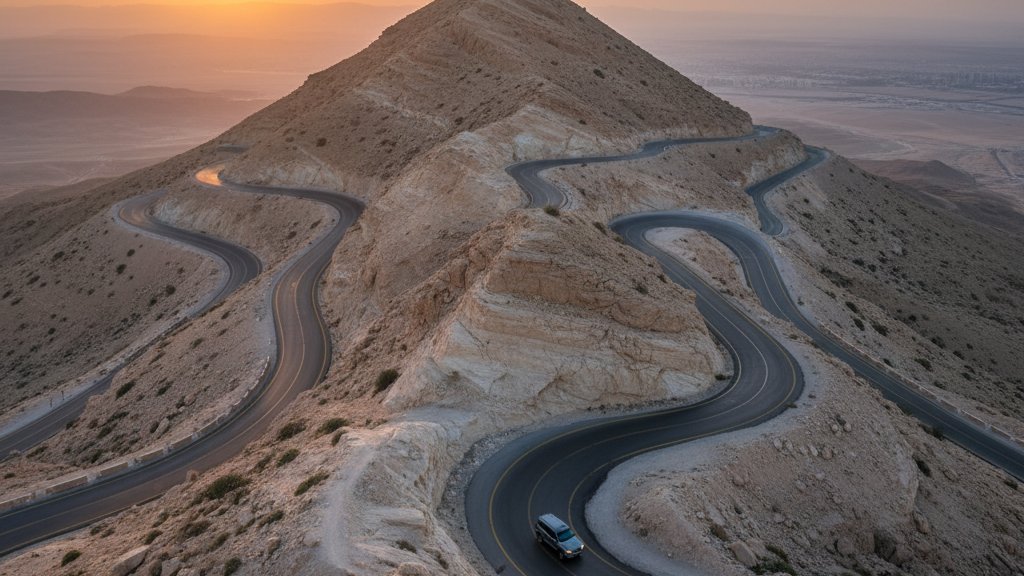
Al Ain International (AAN) is a small airport with limited scheduled traffic; most visitors drive from Dubai or Abu Dhabi and collect a car in the city itself. Rental offices operate near Al Ain Mall or along the airport road. The city is the base for Jebel Hafeet drives, oasis tours and border crossings to Buraimi in Oman. Because Al Ain lies inland at 250 metres elevation, summer temperatures are slightly lower than the coast, though still extreme June to August. Pickup here saves you the two-hour drive from Abu Dhabi if your itinerary focuses on the eastern emirates and Oman.
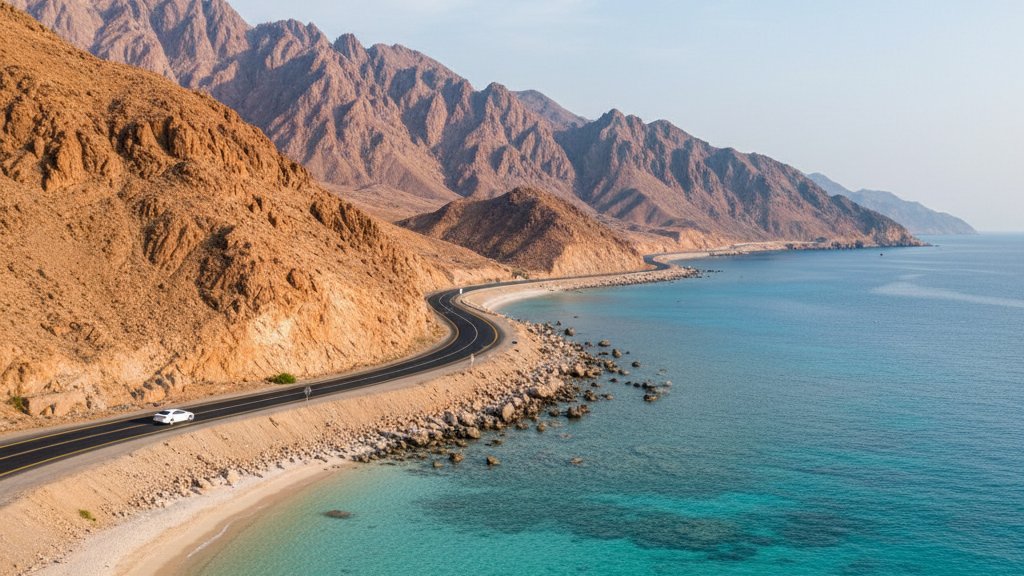
Fujairah International (FJR) handles some cargo and charter flights; passenger traffic is light, and rental desks are not always staffed. Pre-book and confirm the exact pickup time by email. Fujairah city sits on the east coast, 130 km from Dubai across the Hajar mountains. The drive from Dubai via the E102 takes two hours; the drive from Sharjah via the E88 and E102 is slightly shorter. Fujairah is the best base for beach hotels, diving centres and day trips to Dibba or Khor Fakkan. Rental offices in the city are near the Corniche or the main roundabout on Hamad Bin Abdulla Road.
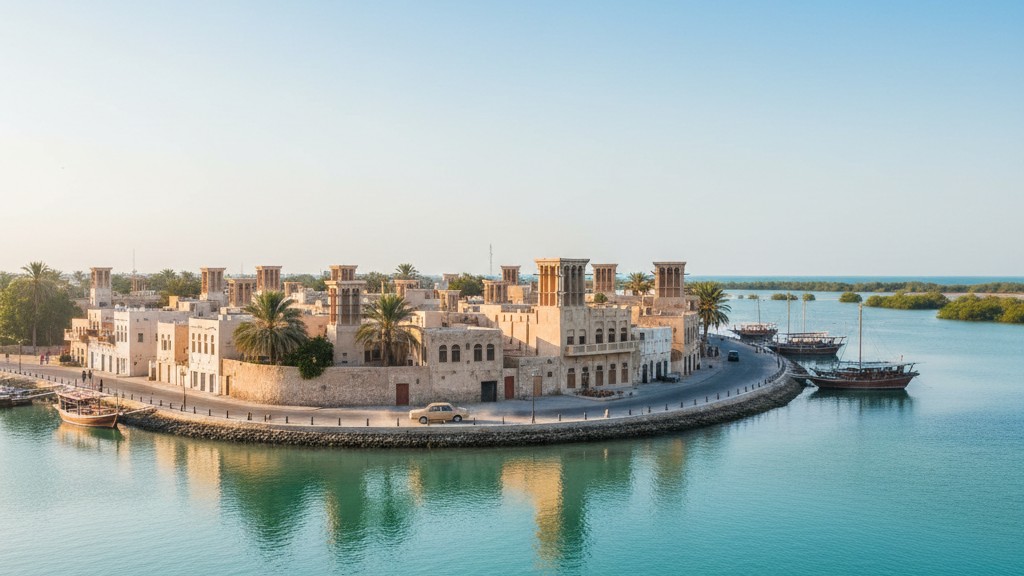
Umm Al Quwain has no airport; the emirate lies between Ajman and Ras Al Khaimah on the E11, forty-five kilometres north of Sharjah. Rental pickup happens at small local agencies on King Faisal Road or near the Marine Club. The town is quiet, the beaches are less developed than Dubai or Abu Dhabi, and rates can be lower because there is no airport premium. Use Umm Al Quwain if you want a tranquil base for exploring the northern coast without the bustle of larger cities, or if you found a monthly car rental UAE deal that saves dirhams over a long-term Dubai booking.
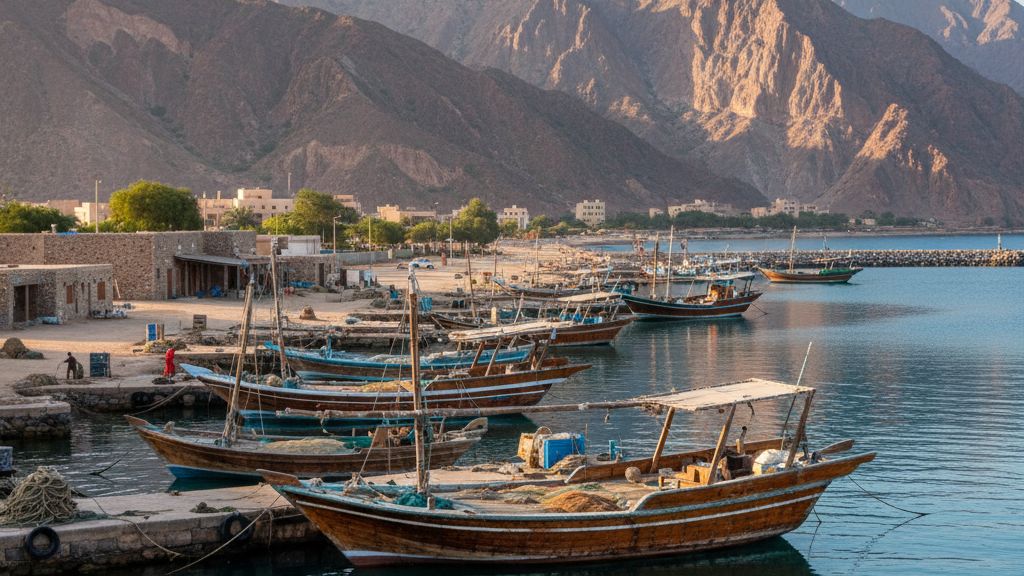
Dibba straddles the UAE-Oman border on the east coast, split into Dibba Al Fujairah (UAE), Dibba Al Hisn (Sharjah enclave) and Dibba Al Baya (Oman). Rental offices are sparse; most travellers collect a car in Fujairah or Ras Al Khaimah and drive to Dibba as a day trip. The road from Fujairah runs north along the coast for forty kilometres, passing small fishing villages and rocky headlands. Dibba port is the departure point for dive boats heading to the Musandam fjords, and the bay offers calm water for kayaking and paddle-boarding. If your hotel arranges car delivery, confirm which Dibba area you are in, because the Omani section requires crossing a border checkpoint.
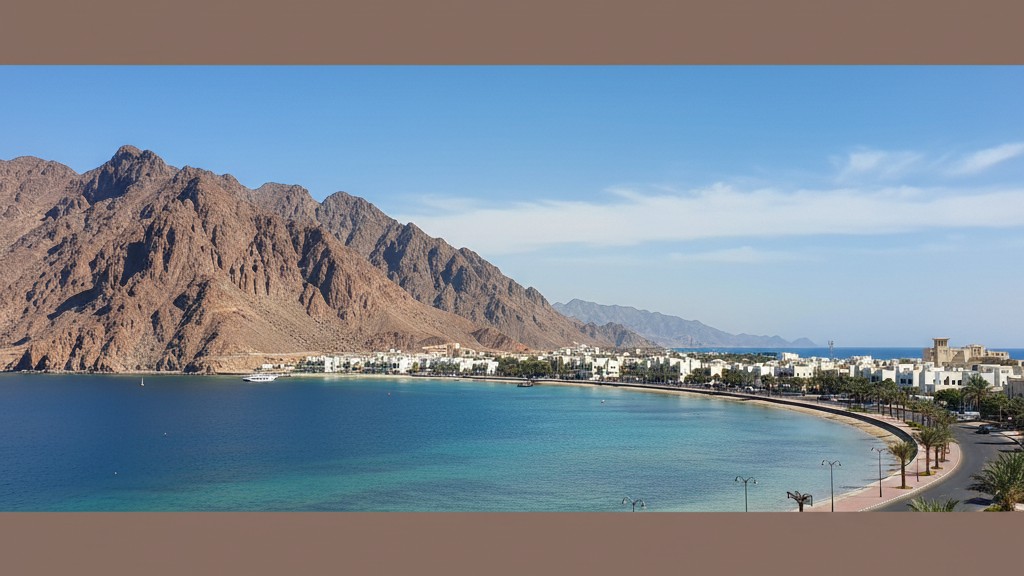
Khor Fakkan is a Sharjah enclave on the east coast, thirty kilometres south of Dibba. No airport, no major rental presence; collect your car in Fujairah or Sharjah and drive. The bay is sheltered, the beach is clean, and the backdrop of jagged mountains is dramatic. A corniche road runs two kilometres along the waterfront with free parking bays; the town centre has a small souk and a fort museum. Khor Fakkan makes a convenient lunch stop on the loop from Fujairah to Dibba, or a quiet overnight if you want to break the journey between Dubai and Musandam without rushing.
Still weighing options or checking details? These ten questions cover the queries that reach our inbox most often. For deeper answers visit our full FAQ page, or read what other travellers report on our reviews page.
When you search for a car in UAE through our site, each result shows whether it carries a deposit requirement. Vehicles labelled "No Deposit" need no blocked funds at pickup - you pay only the rental balance and any extras you ordered. In every emirate practically all cars on offer need no credit card and carry no deposit; the rare exceptions display their deposit amount and payment terms in the listing before you book. Use the filter panel to show only no-deposit options if that is essential for your budget. No deposit is independent of insurance coverage: you still have collision-damage waiver with an excess, but the rental company does not tie up your card limit or hold cash during the trip.
Yes. Nearly every car in search results accepts debit card or cash for the balance payment at pickup. You pay a booking advance by card on our site to secure the reservation, then settle the remainder using the method stated in your voucher - debit card, cash or credit card, depending on what the rental company allows for that specific vehicle. If a model requires a credit card, the listing warns you before you complete the booking. Our payment methods page explains how to raise your debit-card limit if you need extra headroom, and it lists which card networks the rental companies accept at each location.
You pay a booking advance by card on our site; that advance confirms your reservation and counts toward the total rental cost. The remaining balance is due at pickup using the method shown in your voucher - debit card, cash or credit card. The voucher also itemises any extras you ordered: second driver, child seat, Salik toll tag registration, or Oman cross-border permit. Those extras are paid at the counter along with the balance. If a deposit is required - rare, but listed in the search results - the rental company will block that amount on your card separately from the rental charge. The deposit hold releases within a few days after you return the car undamaged.
UAE law states that foreign tourists may drive on a valid licence from their home country for up to three months. An International Driving Permit is not strictly required if your licence is printed in English or Arabic, but many rental companies and some police checkpoints ask for it anyway. We recommend obtaining an IDP from your home motoring authority before you travel; the process takes a few days and costs a small fee, but it avoids confusion at pickup and during roadside checks. Bring both your original licence and the IDP, plus a passport copy, to the rental desk.
Dubai's Salik system uses electronic gantries on major roads: Sheikh Zayed Road, Al Maktoum Bridge, Al Garhoud Bridge and Airport Tunnel. Each crossing costs a few dirhams, debited from a pre-paid account linked to the car's number plate. If you ordered Salik toll tag registration when you booked, the rental company registers the car to your account and invoices you for the crossings after you return. Without the tag you pay a higher admin fee per crossing, billed to your card weeks later when the rental company receives the Salik notice. Abu Dhabi bridges use manual toll booths; keep the receipt if you pay cash, or the charge will appear on a card statement.
Crossing the border to Oman requires written permission from the rental company, arranged before you travel. When you book online, add the "Cross-Border Permit for Oman" extra; the rental company will prepare a letter of authorisation and include it in your documents at pickup. You also need third-party insurance valid in Oman, which the permit covers. At the border post, present your passport, car registration and the letter; most crossings are smooth, but expect a queue during weekends and public holidays. Hatta, Dibba and Al Ain lie close to Omani territory, and short excursions into Musandam or Buraimi are popular day trips if you hold the permit.
At Dubai International (DXB) the rental desks occupy the ground floor of Terminal 1 and Terminal 3, just past baggage claim; signs marked "Car Rental" guide you from customs. At Abu Dhabi International (AUH) the desks sit in the arrivals hall between Terminal 1 and Terminal 3. Look for your rental company's name on the desk fascia, queue if needed, present your voucher and documents, sign the contract, then walk to the adjacent car park where an attendant brings the vehicle. The entire process takes ten to fifteen minutes if the desk is quiet, thirty minutes during peak arrival waves. Some smaller operators use meet-and-greet: you exit the terminal, phone the number in your voucher, and a driver brings the car to a marked bay outside.
Automatic transmission is standard on every sedan, SUV and MPV in the UAE market; manual gearboxes are almost unknown because local buyers avoid them in hot climates and heavy traffic. When you search on our site, the results show transmission type in each listing, and you will see that 100 percent of available cars are automatic. This makes driving simpler for visitors unfamiliar with left-side or right-side differences, and it reduces fatigue in stop-and-go urban queues. If you absolutely need a manual for some reason, contact us by email at [email protected], but we cannot promise availability.
Almost every rental in UAE operates on a full-to-full policy: you collect the car with a full tank, drive as much as you want, and return it full. Photograph the fuel gauge at pickup to prove the start level, then refill at a petrol station within two kilometres of the return point so the gauge reads full when you hand back the keys. If you return the car empty or half-full, the rental company will charge you for the missing fuel at a higher rate than pump price, plus an admin fee. Emarat, ENOC and ADNOC stations are plentiful in cities; ask for "Full, special" to get 95-octane unleaded, and pay by card or cash at the kiosk.
Every booking includes free cancellation up to a specified time before pickup - typically 24 or 48 hours, depending on the rental company and the length of hire. The exact deadline appears in your booking confirmation and voucher. Cancel online through the link in your confirmation email; the system processes the request immediately and refunds the booking advance to your card within five business days. If you cancel after the free-cancellation window closes, you may forfeit the advance or pay a penalty, so check the terms before you commit. Changes to pickup date, time or location may also be free within the same window; contact us by email if you need to adjust your booking.
Every dune, mountain pass, coastal corniche and desert oasis in the UAE waits within a day's drive, and the roads to reach them are smooth, well-signed and open every day. Whether you land in Dubai, stay in Abu Dhabi or cross to Fujairah, a no-deposit, no-credit-card rental car turns scattered landmarks into a connected journey, letting you move at your own rhythm without taxi meters or bus timetables. Search above, compare real-time rates, pay the advance online, and collect your keys at the airport or your hotel within hours.